
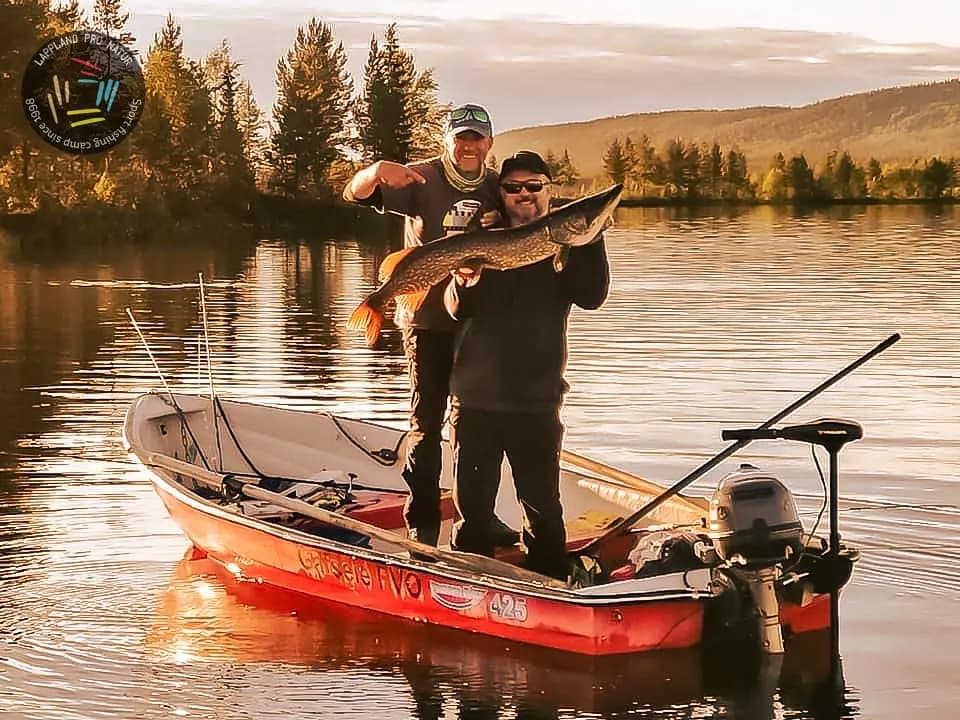
From the south of Sweden to the far reaches of Lapland, the country stretches for almost 2,000 kilometres. The most common mistake is to plan a fishing trip by copying what works in southern Sweden or continental Europe. In Gafsele, the season is packed into four intense months, from 20 May to 20 September.
On this wild land, with fewer than one person per square kilometre, more than 100 kilometres of the Ångermanälven river and a dozen amber-water forest lakes, the depth the fish hold at, the species to target (pike, perch, brown trout, grayling) and the techniques that work change dramatically with the water temperature and the length of the day.
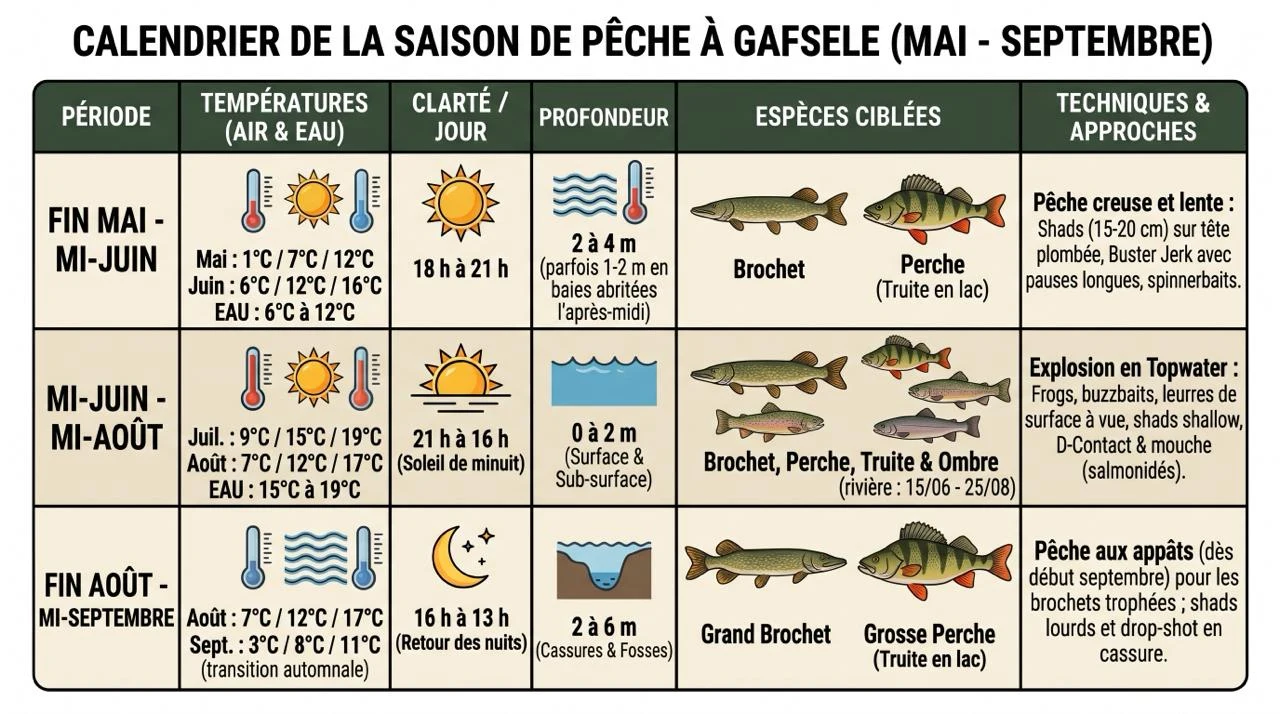
Month by month: temperatures, species and tactics in Gafsele
| Period | Air in Åsele (min / avg / max) | Daylight | Water temp. | Fishing depth | Target species | Key techniques |
|---|---|---|---|---|---|---|
| Late May – mid-June | May: 1 / 7 / 12 °C June: 6 / 12 / 16 °C | 18 to 21 hours | 6 to 12 °C | 2 to 4 m (sometimes 1–2 m in sheltered bays in the afternoon) | Pike, perch (trout in the lakes) | Deep and slow: 15–20 cm shads on jig heads, Buster Jerk with long pauses, spinnerbaits. |
| Mid-June – mid-August | July: 9 / 15 / 19 °C Aug.: 7 / 12 / 17 °C | 21 to 16 hours (midnight sun) | 15 to 19 °C | 0 to 2 m (surface and sub-surface) | Pike, perch, trout and grayling (rivers: 15 June – 25 August) | Topwater frenzy: frogs, buzzbaits, sight-fished surface lures, shallow shads, D-Contact and fly (salmonids). |
| Late August – mid-September | Aug.: 7 / 12 / 17 °C Sept.: 3 / 8 / 11 °C | 16 to 13 hours (nights return) | 13 °C down to 8 °C | 2 to 6 m (drop-offs and holes) | Big pike, big perch (trout in the lakes) | Bait fishing (from early September) for trophy pike; heavy shads and drop-shot on the drop-offs. |
Late May – mid-June
- Air in Åsele (min / avg / max)
- May: 1 / 7 / 12 °C
June: 6 / 12 / 16 °C - Daylight
- 18 to 21 hours
- Water temp.
- 6 to 12 °C
- Fishing depth
- 2 to 4 m (sometimes 1–2 m in sheltered bays in the afternoon)
- Target species
- Pike, perch (trout in the lakes)
- Key techniques
- Deep and slow: 15–20 cm shads on jig heads, Buster Jerk with long pauses, spinnerbaits.
Mid-June – mid-August
- Air in Åsele (min / avg / max)
- July: 9 / 15 / 19 °C
Aug.: 7 / 12 / 17 °C - Daylight
- 21 to 16 hours (midnight sun)
- Water temp.
- 15 to 19 °C
- Fishing depth
- 0 to 2 m (surface and sub-surface)
- Target species
- Pike, perch, trout and grayling (rivers: 15 June – 25 August)
- Key techniques
- Topwater frenzy: frogs, buzzbaits, sight-fished surface lures, shallow shads, D-Contact and fly (salmonids).
Late August – mid-September
- Air in Åsele (min / avg / max)
- Aug.: 7 / 12 / 17 °C
Sept.: 3 / 8 / 11 °C - Daylight
- 16 to 13 hours (nights return)
- Water temp.
- 13 °C down to 8 °C
- Fishing depth
- 2 to 6 m (drop-offs and holes)
- Target species
- Big pike, big perch (trout in the lakes)
- Key techniques
- Bait fishing (from early September) for trophy pike; heavy shads and drop-shot on the drop-offs.
1. Late May to mid-June: ice-out, waking up and post-spawn
In Swedish Lapland, real spring starts at the end of May: statistically, the mild season sets in around 28 May in Åsele, when daily highs pass 14 °C. Sunshine climbs fast and there are already more than 18 hours of daylight a day.
How the fish behave: “cold water, fish deep”
The ice has only just gone and the water is still cold, between 6 °C and 12 °C. The rule on the water in Gafsele never changes: the colder the water, the deeper you fish.
- —Pike: the big fish have only just finished spawning. While the males and mid-sized fish are already on the margins, the very big females (110 to 125 cm and more) recover from the spawn on drop-offs 2 to 4 metres deep. They can sit in 8 metres of water and rise into the 4-metre layer to take prey. Late in the afternoon, when the sun warms the shallow bays sheltered from the prevailing west wind, a quick move onto the 1-metre flats can surprise fish that have come up for a few extra degrees.
- —Perch: schools of big perch (40 cm and over) gather at the foot of rocky drop-offs and in slack water before and after their spawn. You can catch a few.
Techniques that work
With the weed still short, this is the time for lures that fish slowly in the 2 to 4-metre layer:
- —Soft lures (15 to 20 cm shads) on 10 to 20-gram jig heads depending on the current, retrieved slowly and steadily just off the bottom.
- —Sinking jerkbaits and swimbaits (14 to 16 cm), such as the Buster Jerk, with pauses of 3 to 5 seconds: in cold water, the strike almost always comes on the pause.
- —Grubs (3 to 4-inch curly tails) and crankbaits on 10–30 g spinning outfits to trigger the big perch holding on rocky structure.
2. Mid-June to mid-August: the midnight sun and the topwater frenzy
This is the heart of the Lapland summer. Around the summer solstice (20–22 June), the sun rises at 2:17 am and does not set until 11:27 pm: real darkness disappears completely, replaced by a permanent golden twilight, with more than 21 hours of daylight under the clearest skies of the year. In July and early August, daytime highs average 17 °C to 19 °C with no stickiness at all (0% muggy days), and in August the wind drops to its calmest of the year.
The thermal miracle of the Far North
In temperate Europe, summer pike fishing becomes almost impossible, or dangerous for the fish, once the water goes above 26 °C. Here, the flowing water of the Ångermanälven and our forest lakes settle between 15 °C and 19 °C. Predators are at the peak of their metabolic activity, in water full of oxygen.
Fishing 0 to 2 metres: the topwater explosion
From late June to mid-August, life in the water is concentrated between the surface and 2 metres. Pondweed, water lilies and above all white-flowered weed beds cover the 1 to 2-metre flats.
- —Sight fishing pike on topwater: this is Gafsele’s signature. In our light-tea-coloured water (1 to 2 m visibility), watching a pike over 1.20 m lift off in 80 cm of water, push a bow wave behind a frog, a buzzbait or a stickbait and blow up the surface is an adrenaline rush like no other. The low-light windows (between 8 pm and 2 am) give legendary sessions in total silence. It isn’t the most productive time of day, but the experience is unique.
- —Huge catches of trophy perch: in high summer, perch blitz the surface in 1 metre of water. Fishing topwater, sub-surface (small jerkbaits, spinners, spoons) or with soft lures on the shallows can give exceptional days, sometimes 50 to 100 perch or more with a high share of 38 to 45 cm fish (the camp record is 53 cm).
- —Trout and grayling open on the rivers (15 June – 25 August): the perfect time to give one or two days of your week to salmonids. In the oxygen-rich currents of our rivers (trout record 90 cm) or on our upland forest lakes (trout record 71 cm), grayling (Thymallus thymallus) and brown trout feed remarkably hard, on sinking minnows (such as the Smith D-Contact in 50 and 63 mm), spoons and the fly alike.
3. Late August to mid-September: golden colours and bait fishing
From the last week of August until the camp closes in mid-September, Lapland turns quickly to autumn. From 2 September, the average daytime high drops back below 14 °C, settling around 11 °C (3 °C at dawn). Days and nights even out at around 13 hours of daylight, bringing back real starry nights and the first northern lights over the cabins. The wind swings firmly to the south (up to 35% of the time in September) and low autumn skies set in.
The move to the drop-offs (3 to 6 metres)
With the first cold nights, the water drops below 12 °C, then below 10 °C. The marginal weed starts to die back. Schools of whitefish and roach leave the shallows and pack into tight balls in slack current seams, holes and along sharp drop-offs between 3 and 6 metres deep (sometimes down to 8 metres).
Late August: soft lures and drop-off fishing
During the late-August transition, lure fishing is still very productive as long as you go deeper. Put the surface lures away and switch to more heavily weighted 15 to 20 cm shads (10 to 25 g), spinnerbaits slow-rolled along rocky drop-offs and deep-diving crankbaits in contrasting colours (Firetiger / Chartreuse, Orange / Red or Gold / Black / Motor Oil). Big perch also hold in groups near the bottom and respond perfectly to vertical fishing, jig heads, tail spinners and drop-shot.
Early to mid-September: why I recommend bait fishing
From early September, the biology of the big predators changes. To prepare for the long subarctic winter ahead, trophy pike try to store as many calories as possible for as little effort as possible. With the water cooling fast and plenty of natural forage fish packed into the holes, the biggest fish often become selective, or lazy, in front of an artificial lure going past too fast.
That is exactly when, from the first days of September, I strongly recommend switching to bait fishing:
- —Nothing beats natural: presenting a real baitfish from the water itself (roach, whitefish) right at the depth the fish are holding (3 to 6 metres), on a slow drift controlled with the electric motor or static on the fish’s routes, removes all suspicion.
- —A magnet for record fish: the natural scent in cool water and the minimal movement of the bait trigger the heaviest, most wary fish around. It is the end-of-season technique for targeting the massive pike over 110 to 120 cm, at their heaviest of the year.
- —Adapted catch and release protocol: to respect our strict catch and release ethics, bait fishing is done with carefully built rigs (strong steel or titanium leader, barbless hooks) and an immediate strike on the bite, avoiding any deep hooking so the fish can be released in the best possible condition.
Read more
- —How the moon and the midnight sun affect pike.
- —Choosing your lures and the 5 colours for the Ångermanälven river.
- —Our catch and release ethics and the essential tools.