

Planning a week’s fishing months ahead always involves an element of the unknown. Many anglers pore over solunar tables, hoping to guess the exact hour of the feeding frenzy. But at the high latitudes of Swedish Lapland, around Åsele, the moon’s influence on big pike (Esox lucius) can’t be separated from two major factors: the northern photoperiod (hours of daylight) and the water temperature curve.
What scientific studies reveal about the lunar cycle
Modern fisheries research on the pike family (Esocidae) has separated myth from biological reality. The study by Kuparinen et al. (2010) on Esox lucius and the monumental analysis by Vinson and Angradi (2014) of more than 340,000 catches of Esocidae point to precise conclusions:
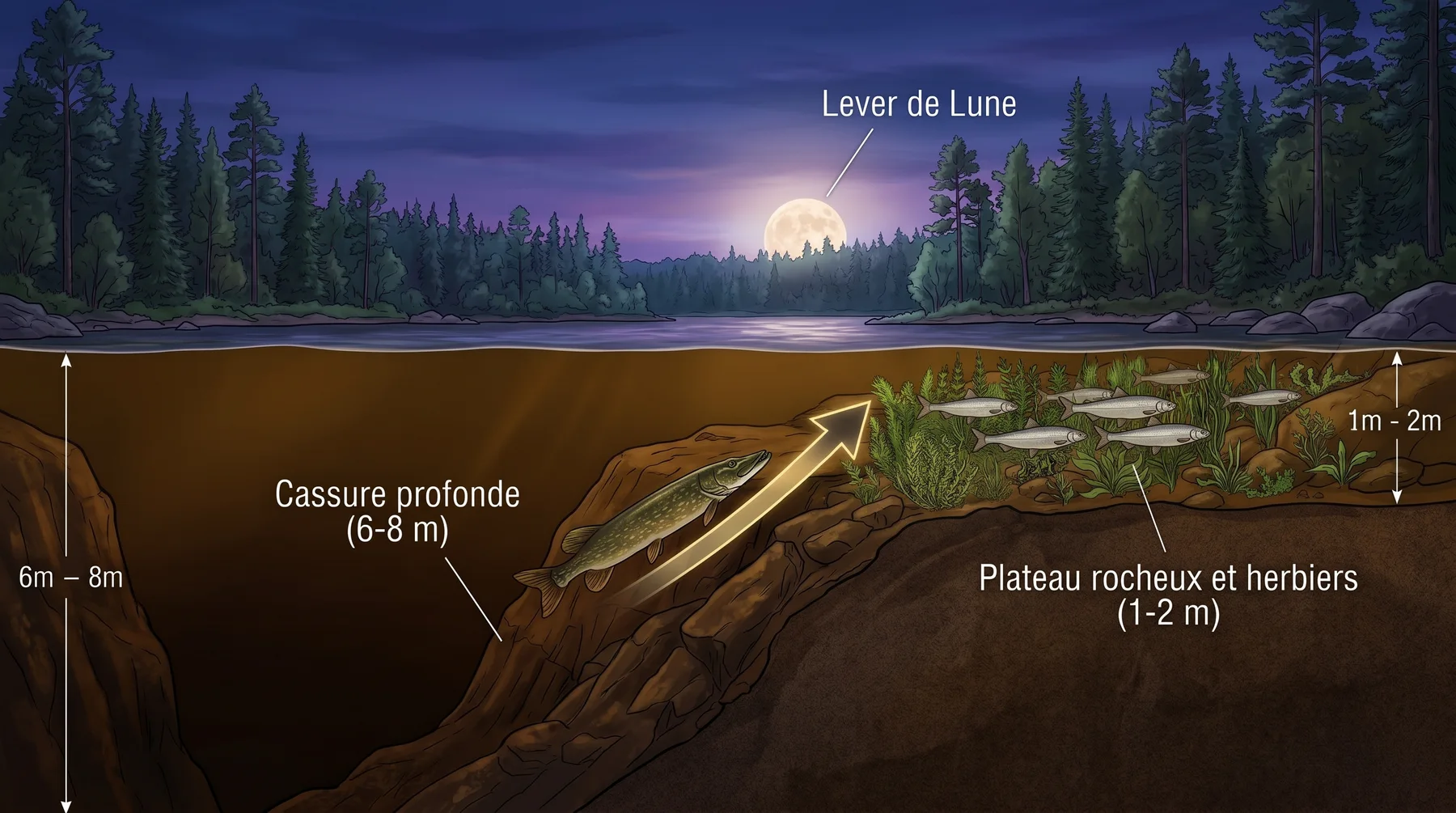
1. The effect of the full moon and new moon: catch rates (CPUE) rise statistically around the new and full moon peaks. This isn’t only down to night-time brightness, but to subtle gravitational variations that change the vertical distribution of zooplankton and, through a chain reaction, the behaviour of prey fish (whitefish, roach).
2. The latitude factor (> 48°N): the data show that the lunar cycle’s influence on catches of Esocidae is much stronger at high latitudes (explaining up to 60% of the cyclical variation in catches) and mainly concerns trophy fish over one metre.
3. Effort and weather come first: on any given day, a drop in water temperature, a steady wind rippling the surface and low fishing pressure over the previous 48 hours always outweigh a poor moon phase.
How activity changes from May to October around Åsele
May to mid-June (post-spawn and a burst of light)
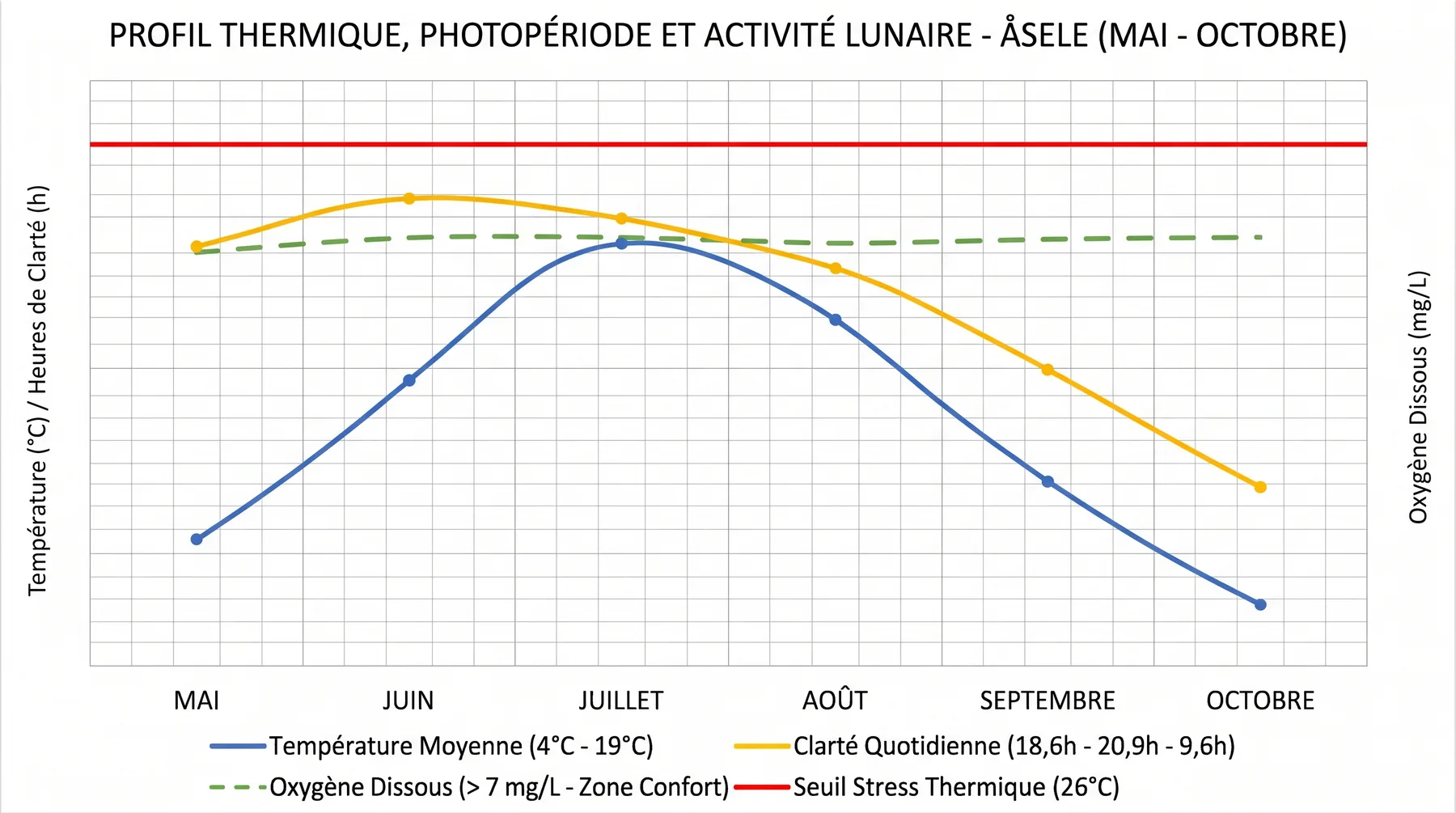
At ice-out, when the water is between 6°C and 12°C, the moon plays a secondary role. The pike’s metabolism is driven by post-spawn recovery and the warming of shallow bays. The days quickly lengthen towards the midnight sun: with no real darkness, the full moon’s brightness counts for little. Activity peaks follow the afternoon rise in temperature and the low, fading light between 9 pm and 2 am.
Lure fishing recommended.
Late June to August (temperature balance)
Unlike temperate lakes in continental Europe, where the water exceeds the critical physiological stress threshold of around 26°C, the Ångermanälven river benefits from constant mixing and cool water coming down from the mountains. The water often settles between 15°C and 19°C, which is the pike’s ideal metabolic window according to Casselman (1978). In July and August the lunar correlation reaches its yearly peak: at the August full moons, when the nights turn dark again, big pike shift their hunting towards dusk and dawn, pushing shoals of whitefish onto the shallows.
Lure fishing recommended.
September to October (pre-winter feeding)
Daylight falls quickly and the water drops below 10°C. Forage fish gather in tight balls in the deep holes and slack water. New moon phases combined with autumn low-pressure systems (wind, cold rain, low cloud) trigger the most aggressive feeding windows of the year for record fish.
Bait fishing recommended.
Scientific references
- Kuparinen, A., Klefoth, T., & Arlinghaus, R. (2010). Abiotic and fishing-related correlates of angling catch rates in pike (Esox lucius). Fisheries Research, 105(2), 111-117. Shows a significant increase in pike catches at full moon, at new moon, at dusk, in steady wind and at cool temperatures.
- Vinson, M. R., & Angradi, T. R. (2014). Muskie Lunacy: Does the Lunar Cycle Influence Angler Catch of Muskellunge (Esox masquinongy)? PLOS ONE, 9(5), e98046. Analysis of 341,959 catches showing a stronger lunar effect above 48° North, especially in July and August and on fish over 102 cm.
- Casselman, J. M. (1978). Effects of environmental factors on growth, survival, activity, and exploitation of northern pike. American Fisheries Society Special Publication, 11, 114-128. The key reference on the thermal and metabolic optimum of pike in cool water (< 20°C).