
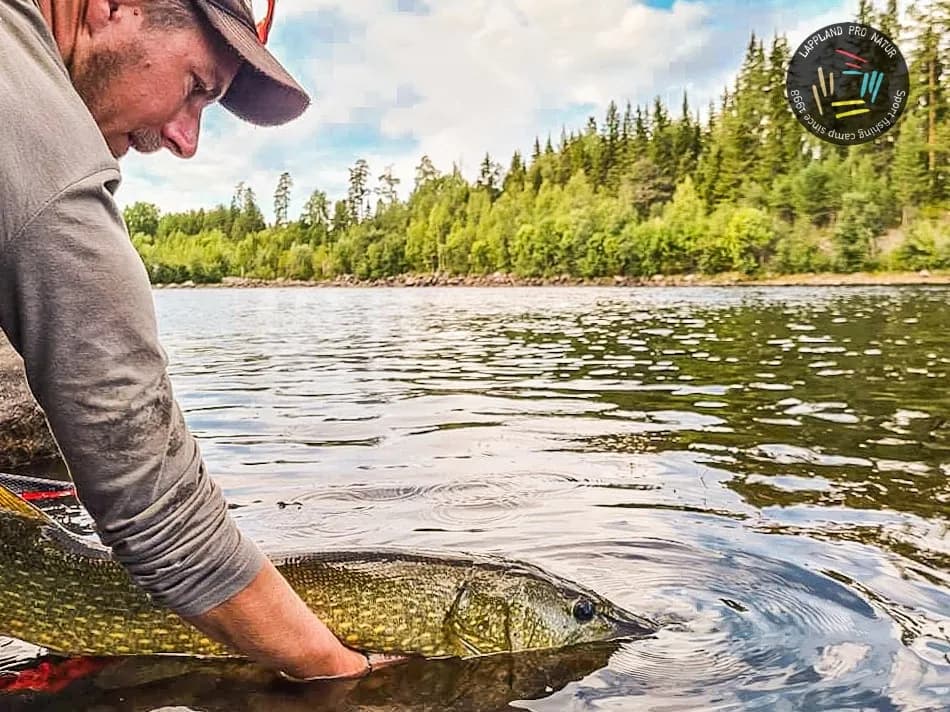
In the waters of Lapland, hooking the fish of a lifetime leaves no room for improvisation. When a metre-long pike hits your lure, the seconds after it goes into the net decide two things: the survival of the predator and the physical safety of the angler. A true “specimen hunter” is known as much by the quality of their unhooking tools as by the rest of their gear.
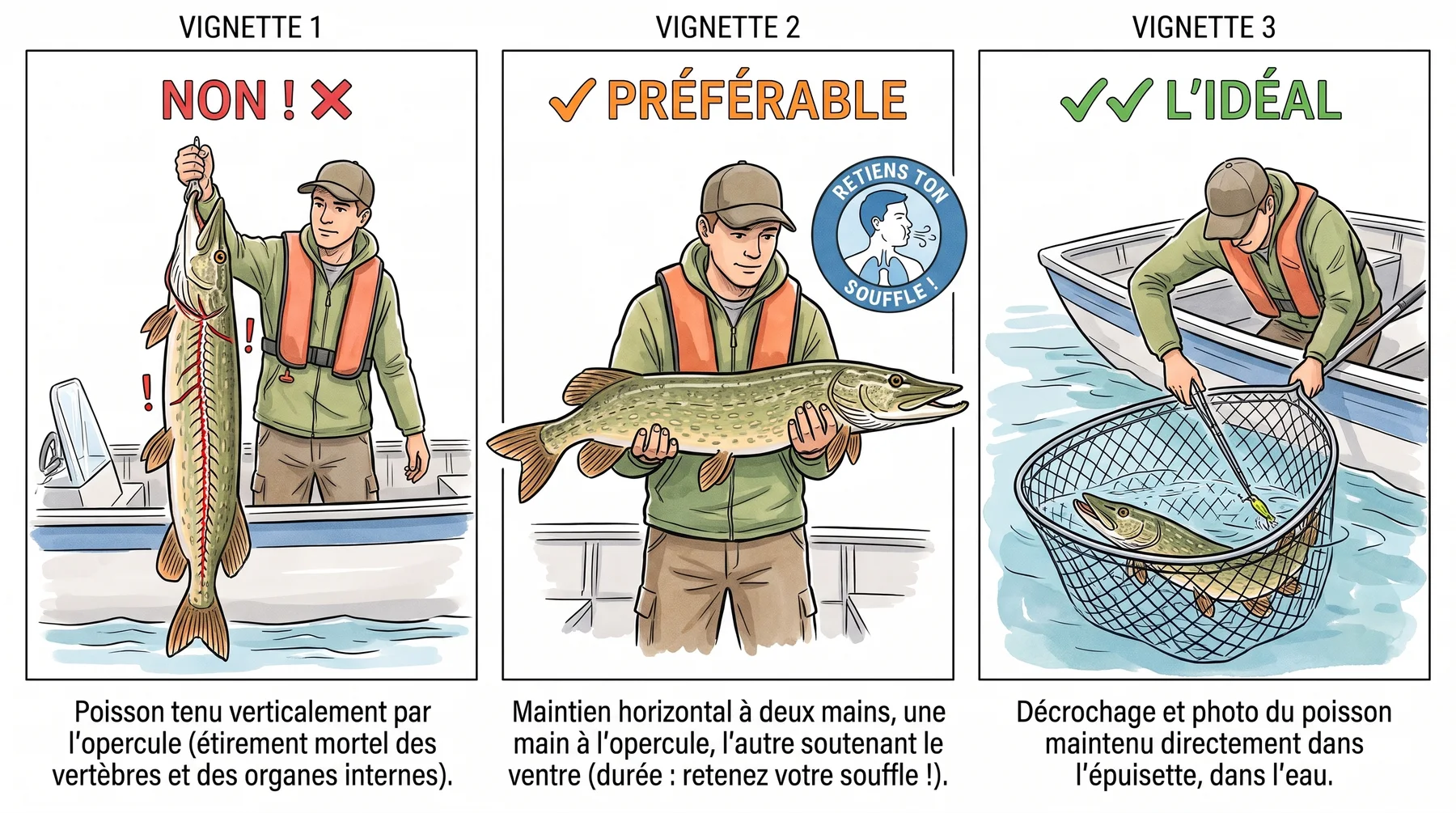
How you handle the fish matters. If you lift it out of the water for a photo, hold your breath. As soon as you need to breathe, the fish needs to go back in the water!
The surgical unhooking kit
As the physiological studies by Landsman et al. (2011) on post-capture stress in the pike family show, every second of exposure to air sharply raises blood lactate and glucose levels. The fish should be unhooked in the water, held in the rubber mesh of a landing net.
Here are the non-negotiable tools to keep within immediate reach (never at the bottom of your tackle box):
- —Crushed barbs, for your safety and easier unhooking.
- —30 cm long-nose pliers: essential for reaching a hook deep in the mouth without putting your fingers near the sharp teeth or the fragile gill arches.
- —Quality compound-action cutters (such as Knipex CoBolt 200 mm): this is life insurance for fish and angler alike. If a size 2/0 or 3/0 treble is lodged near the gills or, worse, driven into the angler’s hand by a sudden head shake, don’t force it: cut through the shanks of the hook in one clean snip. A hook can be replaced in thirty seconds; a dead pike or a damaged tendon can’t!
- —Split-ring pliers and spare trebles, to replace the cut hook straight away and get back to fishing without wasting time.
- —The alternative to the metal jaw spreader: jaw spreaders should be banned for pike because they tear the maxillary membrane when the fish twists. Mastering the gill-cover grip (slide four fingers along the inside of the gill cover, on the smooth bony plate, never touching the red gills, with your thumb locked under the lower jaw) gives you full control and opens the fish’s mouth naturally.
Angler safety
Boating and fishing on waters as vast as the Ångermanälven calls for strict discipline:
- —Automatic life jacket: we take care of equipping you with self-inflating life jackets.
- —Polarised glasses (amber or copper lenses): as well as helping you read the drop-offs in our slightly amber water, they protect your eyes from a lure flying back at high speed when it comes free under tension.
- —First-aid kit and antiseptic for you: handling dozens of pike during a stay inevitably means tiny cuts on your fingers. As fresh water contains natural bacteria, bring an antiseptic skin spray (chlorhexidine), sterile dressings, waterproof tape and liquid skin glue to close and protect scratches instantly.
Scientific references
- Landsman, S. J., Wachelka, H. J., Suski, C. D., & Cooke, S. J. (2011). Evaluation of the physiology, behaviour, and survival of adult muskellunge (Esox masquinongy) captured and released by specialized anglers. Fisheries Research, 110(2), 377-386.