On a river and lake system as vast as the Ångermanälven around Gafsele and Åsele, the classic mistake is to change lures every ten minutes instead of covering water. As the golden rule of serious pike hunters says: when you’re searching, forget complicated gadgets and choose lures with a high hook-up rate that can cover ground quickly over varied structure.
Understanding the local habitat: stained water, rocks and current seams
Our stretch of the Ångermanälven has a distinctive topography that directly dictates your choice of lures:
1. Water colour: slightly stained by humic acids from the boreal forests and surrounding peat bogs (weak tea to amber), with average visibility of 1 to 2 metres.
2. Two kinds of structure: the river alternates between shallow bays rich in vegetation (horsetails, pondweed, water lilies), slack water, and formidable rocky structures (submerged points, fields of glacial boulders, sharp drop-offs falling from 2 to 10 metres).
3. The larder: here, big pike feed on silvery, streamlined open-water prey, mainly whitefish and roach, and on the perch that are plentiful along the edges.
The 4 essential lure families for our waters
1. Spinnerbaits and bucktails (search lures)
For combing reed edges in spring or skimming over boulders without snagging, nothing beats a sturdy spinnerbait with Colorado or Willow blades, or a big bucktail. On a steady retrieve, the low-frequency vibrations and metallic flashes cut through the amber water and trigger explosive reflex strikes.
2. Soft swimbaits / shads (12 to 20 cm) on adjustable rigs
This is the modern way to fish the drop-offs of the Ångermanälven. Rigged with a screw-in head and a belly stinger with two needle-sharp trebles, they let you adjust the weight (from 5 g in the shallows over weed beds up to 30–40 g to hold in the current in holes of 6 to 8 metres). Their powerful rolling action perfectly imitates a big whitefish or a drifting bream.
3. Jerkbaits and gliders (14 to 18 cm, suspending / slow sinking)
Ideal over plateaus of 1 to 3 metres and along rocky points in calm weather. The trick on our waters is to make clear pauses of 2 to 4 seconds: it’s almost always on the pause, when the lure hangs in the water, that big following fish engulf it.
4. Lipped crankbaits and jointed twitchbaits
Perfect for covering ground between two rocky spots or searching drop-offs swept by the current. The lip knocking against pebbles and rocks imitates fleeing prey and wakes up sluggish fish hugging the bottom.
The 5-colour rule on the Ångermanälven
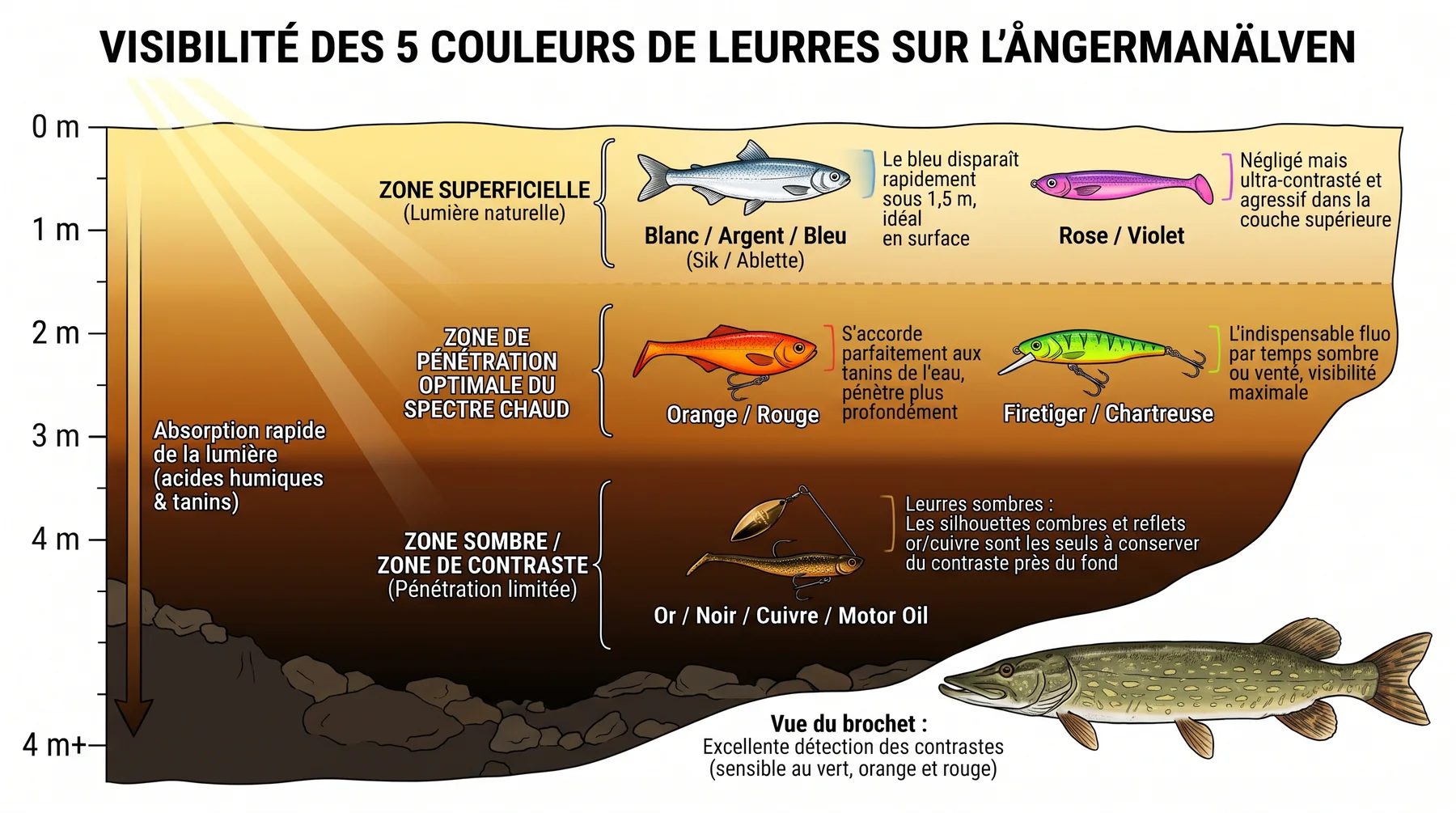
Just as historical statistics compiled from thousands of catches show that a handful of colours account for most of the results, five shades clearly dominate in the waters of Västerbotten:
- —Gold / black / copper (Motor Oil, Gold Perch, Black/Gold): the absolute standard, blending in with a flash in tannin-stained water under a sunny or hazy sky.
- —White / silver / blue: an exact imitation of whitefish and bleak, deadly whenever pike are hunting in open water or on windy points.
- —Firetiger / chartreuse: the essential contrast colour in rain, strong wind or on the dark days of September and October.
- —Orange / red: perfectly suited to the tannins in the water.
- —Pink / purple: colours often overlooked for pike, yet they’ve been a safe bet here for years.
Rods, main line and leaders: the perfect balance for the Ångermanälven
The same mistake comes up every season among those discovering Sweden: arriving over-equipped with ultra-stiff big-bait rods of 150 to 250 grams. These crowbars may make sense on the big open lakes of the south, for launching 200 g lures all day, but they soon become exhausting and counter-productive around Gafsele.
Here, fishing is mainly active searching between the surface and 4 metres, moving between rocky points, weed edges, plateaus thick with weed and current seams. Lightness and casting accuracy matter more than sheer size.
1. The ideal trio of rods (provided at the camp)
Feedback from hundreds of anglers in Lapland shows that two power ranges are enough to cover 100% of situations for pike and perch:
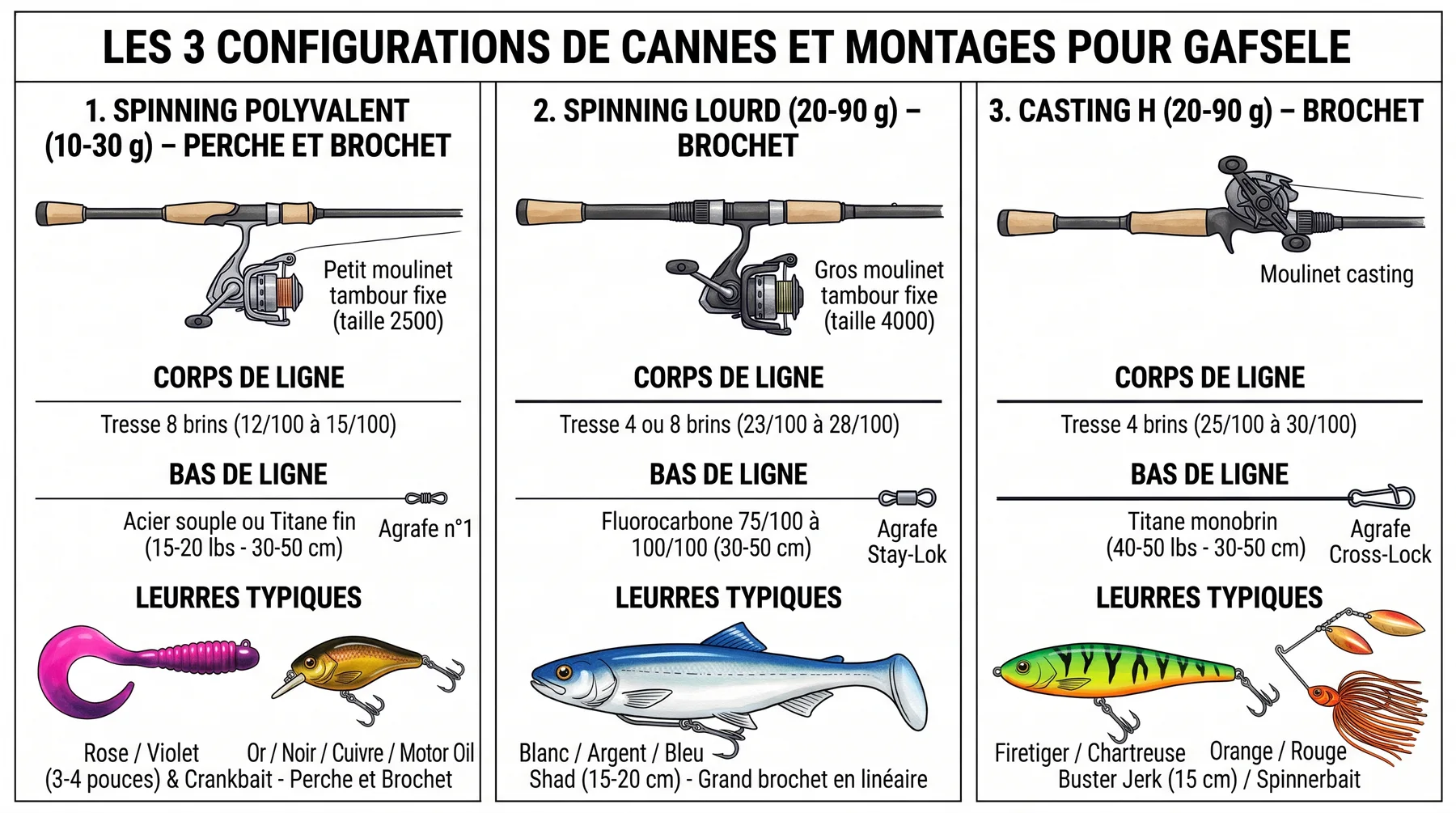
The light all-rounder, spinning 10–30 g (2.10 to 2.25 m, fast action): the fun rod par excellence. Designed first for big perch on 3 to 5-inch soft lures or blade baits, it has enough power in the butt to calmly handle the many 50 to 75 cm pike that regularly turn up on perch spots.
The go-anywhere pike outfit, spinning 20–90 g (2.20 to 2.40 m): fitted with a size 4000 fixed-spool reel, this rod easily handles spinnerbaits, spoons, crankbaits, jerkbaits and 12 to 18 cm shads. It’s the tireless tool for combing the water into the wind without ever risking a wind knot.
The heavy outfit, casting 20–90 g (2.20 to 2.35 m): paired with a size 200 or 300 baitcasting reel. Casting gives you direct contact with the lure on the drop, pinpoint accuracy for landing a lure right next to a stump or a line of horsetails, and greater leverage for working jerkbaits and gliders or setting the hook hard in a metre-long fish at long range.
The guide’s advice: no need to overload your rod tubes on the plane. These exact three set-ups (spinning 10–30 g, spinning 20–90 g and casting 20–90 g) are provided on site, perfectly balanced for our waters.
2. Main line: 4-strand vs 8-strand braid (forget nylon!)
Nylon (monofilament) main line should be banned for pike on lures. Its stretch absorbs the energy of the strike at long range, stopping big (often thick) hooks from penetrating the pike’s bony jaw, and its softness completely dulls the feel of light takes or contact with the rocks.
On pike outfits (20–90 g): go for a 0.23 to 0.28 mm braid (30 to 40 lb / 15 to 20 kg).
The pros’ trick around rocks: while 8-strand braid glides silently on a spinning rod, many guides and experienced anglers in Sweden still prefer a good 4-strand braid for casting, because it’s much more resistant to abrasion against rocks and cuts more easily through weed stems.
On the perch / light outfit (10–30 g): a 0.12 to 0.15 mm 8-strand braid (12 to 16 lb) lets you cast small lures a long way while keeping a safety margin for pike.
3. Leaders: the fluorocarbon, titanium and steel debate
This is the most hotly debated subject of all… On the Ångermanälven, where the water is slightly amber but clear (visibility of 1 to 3 m) and the pike have fearsome teeth, here’s what works on the water, in pictures:
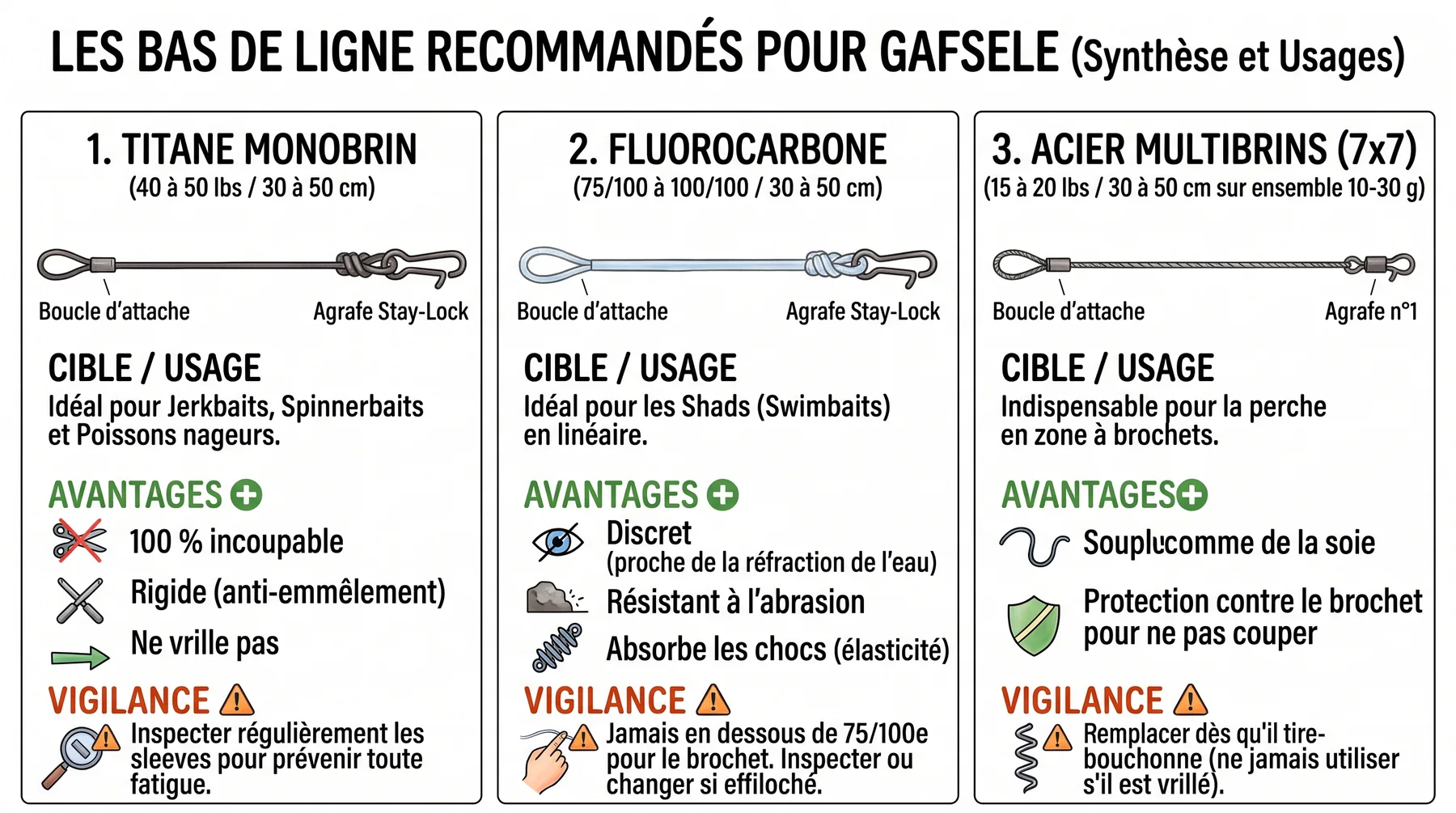
The detail that saves the fish of the trip: at the end of your leader, ban thin entry-level snaps that open when a jaw twists. Only use reinforced Stay-Lok or Cross-Lock snaps (70 to 100 lb), with a quality barrel swivel to prevent line twist if you’re using bladed lures or spoons.